The execution of the Softmax function in Python is a straightforward task. This can be achieved using NumPy or frameworks for deep learning like PyTorch and TensorFlow. Primarily, the Softmax Function is utilized for classification issues. It assists in transforming raw scores into probability distributions, ensuring that the aggregate of the outputs totals to 1.
In this article, I will elucidate how the Softmax Function can be instantiated in Python. So let’s dive in!
Contents
- What is the Softmax Function?
- Why utilize the Softmax Function?
- What is the procedure to implement the Softmax function in Python?
- Softmax vs. Other Activation Functions: Which one to choose?
- In what way is Softmax Applied in Various Deep Learning Models?
- The Role of Softmax in Transformers & NLP Models
- Selection of Softmax Policy in Reinforcement Learning?
- What makes Softmax crucial in RL?
- Executing Softmax Policy Selection in Python
- Tuning Temperature (T) in Softmax Policy
- Summary
- Frequently Asked Questions:
What does the Softmax Function entail?
The Softmax Function is instrumental in converting unrefined scores into probabilities, ensuring that their sum equals 1. In the context of multi-class classification challenges, it is applied in the terminal layer of neural networks.
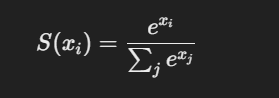
Formula for Softmax:

Where
- Every value xi is raised to the power of e.
- The total of all exponentiated values is computed.
- Every exponentiated value is divided by the sum of all exponentiated values, ensuring that the output remains between 0 and 1.
Thus, this method simplifies the interpretation of outputs as probabilities.
What are the benefits of using the Softmax Function?
- It assists in converting outputs into probabilities (beneficial for classification).
- It aids in preserving numerical stability (ensures values are within a manageable range).
- It simplifies the decision-making process (highest probability equates to predicted class).
How is the Softmax function implemented in Python?
Now, let’s explore various approaches to executing the Softmax Function in Python.
Technique 1: Building Softmax from the Ground Up
Illustration:
Output:

Note: Why should you deduct np.max(x)?
Answer: This is essential as it averts large exponentials, which aids in mitigating the possibility of overflow errors.
Explanation:
The code above is utilized to demonstrate the execution of the Softmax Function in NumPy. It transforms an array of logits into probabilities by exponentiating the values, normalizing them, and confirming that the total equals 1.
Method 2: Utilizing Softmax from SciPy
Instead of manually implementing Softmax, you can apply SciPy's built-in function.
Example:
Output:

Explanation:
The preceding code employs Scipy’s Softmax Function. It transforms an array of logits into probabilities, guaranteeing that their sum equals 1.
Method 3: Implementing Softmax in PyTorch
In case you're utilizing a deep learning model, PyTorch provides an intrinsic Softmax function.
Example:
Output:

PyTorch’s softmax facilitates seamless integration with deep learning frameworks.
Explanation:
The aforementioned code utilizes PyTorch’s Softmax Function, which assists in converting logits to probabilities along dimension 0, ensuring they total up to 1.
Method 4: Implementing Softmax in Tensorflow/Keras
Should you need to use Softmax in Keras, it can be directly applied within TensorFlow.
Example:
Output:

With assistance from TensorFlow, applying the Softmax Function in neural networks becomes straightforward.
Explanation:
The provided code executes TensorFlow’s tf.nn.softmax(). This function converts logits into probabilities, making sure they total 1.
Softmax vs. Other Activation Functions: Which should you utilize?
Selecting the appropriate activation function is crucial when working with neural networks. The Softmax Function is commonly utilized in multi-class classification, and it can be compared with other activation functions, such as Sigmoid, ReLU, and Tanh. In this portion, we will dissect these functions to aid you in deciding which one to implement.
Method 1: Softmax vs Sigmoid
| Feature | Softmax | Sigmoid |
| Definition | Transforms logits into probabilities that sum to 1. | Maps values to a range between 0 and 1. |
| Use Case | Multi-class classification | Binary classification or multi-label tasks. |
| Formula |  |  |
| Output Range | [0,1] (sum of all values = 1) | [0,1] (independent values) |
| Interpretation | Probabilities associated with each class. | Probability of an individual event occurring. |
| Key Limitation | Inapplicable for multi-label classification. | Does not scale effectively to multiple classes. |
When to Utilize:
- Softmax: This function is suitable for Softmax when there is one correct class for each sample (for instance, image classification).
- Sigmoid: This can be applied when multiple classes may be true simultaneously (like in multi-label classification).
Method 2: Softmax vs ReLU (Rectified Linear Unit)
| Feature | Softmax | ReLU |
| Definition | Converts logits into a probability distribution. | The input yields either a positive output or 0. |
| Use Case | Applied when the final layer is focused on multi-class classification. | Employed in hidden layers of deep networks. |
| Formula |  |  |
| Output Range | [0,1] (probabilities) | [0, infinity) |
| Gradient Issue | No vanishing gradient concern. | May result in a dying ReLU problem (neurons stuck at 0). |
When to Utilize:
- Softmax: Applicable only in the final layer during multi-category classification.
- ReLU: Can be incorporated in hidden layers for quicker and more efficient training.
Method 3: Softmax vs Tanh (Hyperbolic Tangent)
| Feature | Softmax | Tanh |
| Definition | Facilitates normalizing values to a probability distribution. | Maps inputs to a range between -1 and 1. |
| Use Case | Employed in the output layer for multi-class classification. | Utilized in hidden layers of deep networks. |
| Formula |
``` |  |
| Output Interval | [0,1] | [-1,1] |
| Main Advantage | This guarantees that the probabilities total 1. | It aids in establishing centered activations (mean of zero). |
When to apply:
- Softmax: It is applicable for multi-class categorization.
- Tanh: It performs efficiently in hidden layers, proving superior to Sigmoid because it is centered around zero.
How is Softmax Applicable in Various Deep Learning Architectures?
Convolutional Neural Networks (CNNs) for Image Recognition
Softmax is primarily utilized in the final layer of a CNN to facilitate the classification of images into distinct categories.
Example:
- Input: A picture of a dog.
- Output layer (pre-Softmax): Raw values = [4.2(Dog), 2.1 (Cat), 0.5 (Bird)]
- Post-Softmax: Probabilities = [0.85 (Dog), 0.10 (Cat), 0.05 (Bird)]
The model identifies as “Dog” due to having the greatest probability.
Softmax in Transformers & NLP Frameworks
In Natural Language Processing (NLP), Softmax finds extensive use in:
- Text Categorization (e.g., Sentiment Analysis): It is employed to allocate a probability to each category, such as Positive, Negative or Neutral.
- Large Language Models (e.g., GPT, BERT): It is employed to ascertain the subsequent word by ascribing probabilities to vocabulary items.
- Attention Mechanisms (Transformers): It assists in distinguishing the importance of various words in a sentence, benefiting the determination of significant words.
Example:
In machine translation (English -> French), Softmax aids the model in forecasting the most likely next word from a vocabulary.
Softmax Policy Selection in Reinforcement Learning
Softmax policy selection is a technique for choosing actions in RL, based on their anticipated rewards. Unlike greedy strategies, it consistently selects the action with the maximum value. The Softmax function is employed to assign a probability to every action.
Mathematical Representation of Softmax in RL

Where:
- P(a) = Indicates the likelihood of selecting action a.
- Q(a) = Indicates the estimated value (reward) associated with action a.
- T = Represents the Temperature parameter that influences exploration.
- ∑b​eQ(b)/T = Represents Normalization factor that guarantees all probabilities sum to 1.
Why is Softmax Significant in RL?
Assists in Avoiding Greedy Strategy Flaws
- A reliable greedy approach is beneficial for selecting the action with the highest estimated value. However, initial estimates can sometimes be misleading.
- Prior to finalizing a strategy, the dynamics of Softmax assist the agent in exploring distinct actions.
Facilitates the Equilibrium of Exploration and Exploitation
- A heightened temperature (T) can lead to excessive exploration, which may hinder learning progress.
- Premature exploitation can occur with a lower T, potentially leading to missed superior long-term strategies.
- Softmax effectively achieves a balance that enhances decision-making.
It is practical in Large Action Spaces
- Greedy approaches struggle with efficient exploration in scenarios where numerous possible actions exist.
- Softmax is applied to assign probabilities to actions, ensuring a varied and well-informed exploratory approach.
Implementing Softmax Policy Selection in Python
Now, let’s examine the implementation of Softmax Policy Selection in Python using NumPy and PyTorch.
Method 1: Implementation using NumPy
Example:
Output:

Clarification:
The aforementioned code demonstrates the execution of Softmax Action Selection in the context of reinforcement learning. It is designed to determine action probabilities utilizing the Softmax Function and randomly selects an action based on these probabilities. The temperature parameter is critical for balancing exploration against exploitation.
Method 2: Execution utilizing PyTorch
Sample:
Output:

Clarification:
The code snippet above demonstrates Softmax Action Selection within PyTorch. It utilizes the Softmax Function on Q-values (modified by temperature). Subsequently, an action is sampled based on the derived probabilities employing torch.multinomial().
Modifying Temperature (T) in Softmax Policy
- High Temperature (T > 2.0): The model engages in extensive exploration, randomly selecting actions. This is advantageous during the model’s initial learning period.
- Moderate Temperature (T = 1.0): A balanced method is adopted here, combining exploration with the selection of the best-known actions.
- Low Temperature (T < 0.1): In this case, the model primarily opts for the most recognized action, concentrating on the strategies that yield the best results for the model. This approach is optimal for the later stages of training.
Summary
An essential concept in machine learning, especially in reinforcement learning and classification tasks, is the Softmax function. It plays a critical role in deep learning models, RL action selection, and multi-class categorization as it transforms raw scores into probabilities.
Having knowledge of how Softmax operates, how it differentiates from other activation functions, and how to manipulate its characteristics via the temperature parameter allows for improved decision-making with your models. Mastering Softmax can enhance performance, whether you are training an RL agent for decision-making or building a neural network for image classification.
Frequently Asked Questions:
The Softmax Function serves in classification tasks, aiding in converting raw logits (scores) into probability distributions, which makes it beneficial for multi-class classification challenges.
The Softmax Function can be enacted in Python using NumPy as follows: Example:
 Clarification: The previous code snippet is designed to implement the Softmax Function using NumPy. This method ensures numerical stability by subtracting the maximum value from logits prior to applying exponential functions. Following that, it normalizes the values into a probability distribution.
Certainly! You can employ built-in functions for Softmax in Python. Libraries such as SciPy, PyTorch, and TensorFlow offer native implementations of Softmax.
- SciPy: scipy.special.softmax()
- TensorFlow: tf.nn.softmax()
- PyTorch: torch.nn.functional.softmax()
The subtraction of np.max(x) in the Softmax implementation is performed to enhance numerical stability. It mitigates overflow errors during exponential computations, thereby ensuring that values do not escalate excessively.
Softmax can be executed in PyTorch by: Example:
Output:

Explanation: The code presented above is utilized to apply the Softmax Function to a tensor of logits utilizing PyTorch. It subsequently transforms them into a probability distribution along dimension 0.
The article How do you implement the Softmax function in Python? was first published on Intellipaat Blog.
```